
 Spark Energy Minerals
Vancouver, British Columbia--(Newsfile Corp. - October 8, 2026) - Spark Energy Minerals Inc. (CSE: SPRK) (OTC Pink: SPARF) (FSE: 8PC) ("Spark" or the "Company") reports channel and grab sampling results that point to a second rare earth target style at Cruzeta, within its approximately 91,900-hectare Arapaima Project in Minas Gerais, Brazil.
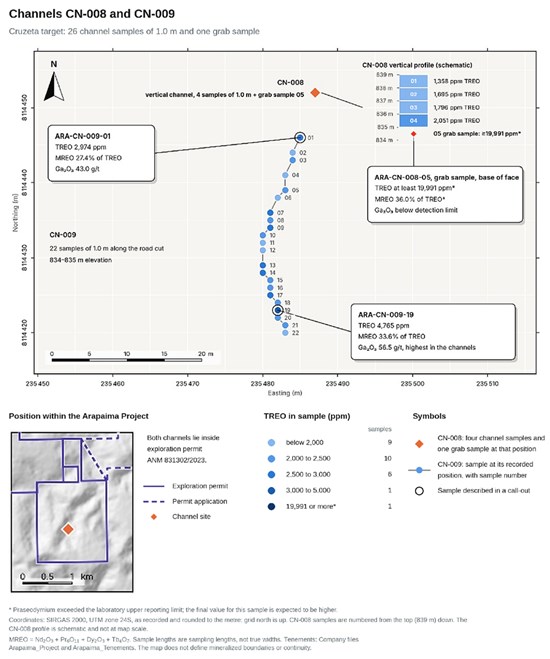
A grab sample of lightly weathered granite at the base of the road-cut face returned 19,991 ppm (2.00%) total rare earth oxides (TREO), the highest rare earth assay of any single sample the Company has reported at Arapaima. This is granite, not clay, pointing to a different exploration target from the Company's interpreted clay-hosted rare earth mineralization. The sample was collected by hand, not cut over a measured length; it is not comparable to channel or drill results and is not representative of the granite or the target.
In that sample praseodymium exceeded the upper limit of the laboratory method, so the 2.00% counts praseodymium only up to that limit. An over-limit analysis has been requested from the laboratory, and the final value is expected to be higher.
Granite-Hosted Rare Earths Point to a Second Target Style at Cruzeta
"Here, the channels expose the rare earth zone right at surface, while our nearest drill holes encounter it 22 to 42 metres down, consistent with our model of a vertically zoned weathering profile. The grab sample is granite, not clay, which opens a second target style at Cruzeta beyond our ionic clay model. One sample does not make a deposit, so our first follow-up is a drill hole at the top of the road cut."
"Strategically, Cruzeta is where we are building the technical foundation for everything that follows at Arapaima. The sequence is clear: drill beneath the road cut, report the remaining drill holes, and plan the infill drilling that any future mineral resource estimate would require, all subject to financing. A rigorous, verifiable technical record is what allows a company at our stage to engage strategic partners, institutional investors and public agencies with credibility. With approximately 91,900 hectares, 100% owned, and a second discovery already made at Boa Vista, that is the opportunity we intend to pursue, one disciplined step at a time." — Dr. Fernando Tallarico, P.Geo., FSEG, Chief Executive Officer & Chairman
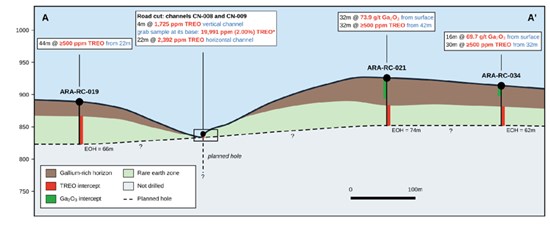
A road cut is the exposed face created where ground is excavated to build a road. At Cruzeta, it gives geologists direct access to the weathered profile and underlying granite. The section below shows how this exposure relates to nearby drilling and the proposed drill test.
To view an enhanced version of this graphic, please visit:
https://images.newsfilecorp.com/files/10093/318021_f0c45c58041b6bdf_001full.jpg
High Grades and Magnet Rare Earth Shares Strengthen the Surface Target
- Grab sample ARA-CN-008-05: 19,991 ppm (2.00%) TREO. Lightly weathered granite at the base of the road-cut face, with magnet rare earth oxides (MREO) accounting for at least 36.0% of TREO. The final TREO, MREO and NdPr values are expected to be higher: see "Technical Notes and Reporting Basis".
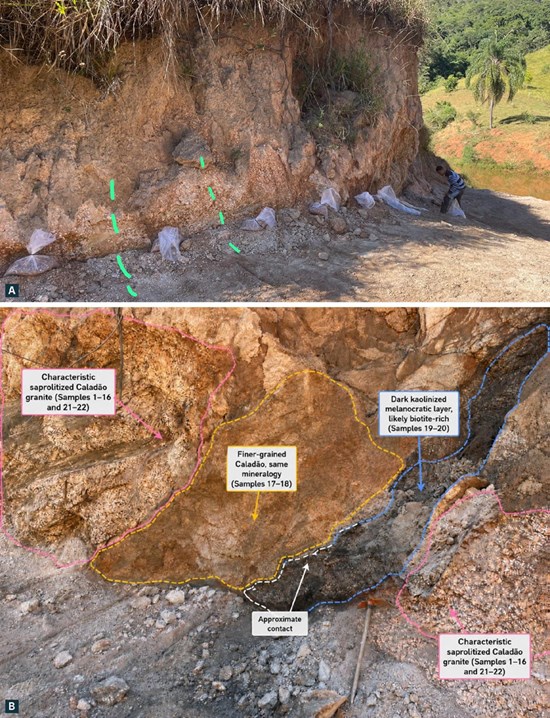
- Horizontal channel CN-009: 22 m averaging 2,392 ppm TREO, peak 4,765 ppm. Every one of the 22 one-metre samples exceeds 1,600 ppm TREO.
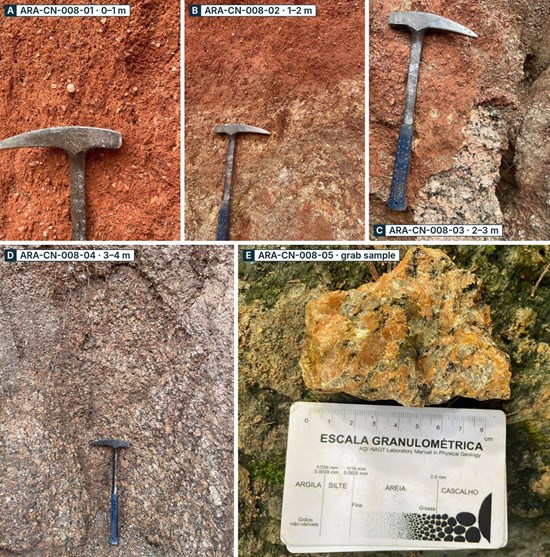
- Vertical channel CN-008: 4 m averaging 1,725 ppm TREO. TREO rises down the channel, from 1,358 ppm in soil at the top to 2,051 ppm in saprolite at the base.
- Peak magnet rare earth shares: 34.0% of TREO in CN-009 and 28.6% in CN-008. These are individual channel-sample ratios, distinct from the grab sample's minimum 36.0%.
- Average magnet rare earth shares: 28.6% of TREO across CN-009 and 21.2% across CN-008. Channel ratios are total MREO divided by total TREO.
22 m Channel Averages 2,392 ppm TREO Across the Sampled Face
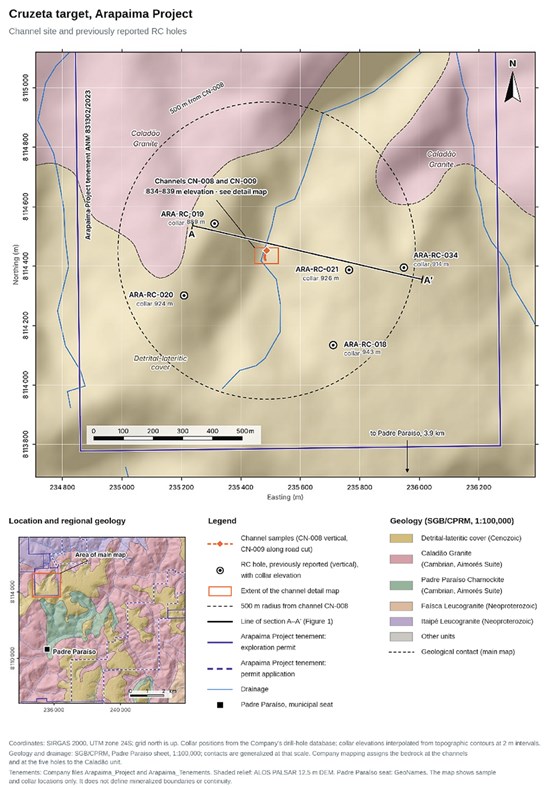
The program comprised 26 one-metre channel samples and one grab sample (Figures 2 and 3). CN-008 is a 4 m vertical channel cut down the road-cut face, from soil at the top to saprolite at the base. CN-009 is a 22 m horizontal channel that starts about 6 m from CN-008 and follows the face southward. ARA-CN-008-05 is a grab sample of the lightly weathered granite exposed at the base of the face, directly below CN-008. Results for every sample, with coordinates, are in the Appendix.
No new drill holes are reported. Surface samples do not establish the thickness, continuity or depth extent of mineralization.
| Channel or sample | Type | Length (m) | TREO average (ppm) | TREO maximum (ppm) | MREO/TREO average (%) | MREO/TREO maximum (%) |
|---|---|---|---|---|---|---|
| CN-008 | Vertical channel | 4 | 1,725 | 2,051 | 21.2 | 28.6 |
| CN-009 | Horizontal channel | 22 | 2,392 | 4,765 | 28.6 | 34.0 |
| ARA-CN-008-05 | Grab sample | - | - | 19,991* | - | 36.0* |
Averages are of consecutive one-metre channel samples; MREO/TREO averages are total MREO divided by total TREO. ARA-CN-008-05 is a single grab sample: its values are individual results, and it is not part of channel CN-008. * Final value expected to be higher: see "Technical Notes and Reporting Basis".
Every CN-009 sample exceeds 1,600 ppm TREO (Photo 1). The highest, ARA-CN-009-19, returned 4,765 ppm TREO with 33.6% MREO. The channel averages describe the sampled face.
To view an enhanced version of this graphic, please visit:
https://images.newsfilecorp.com/files/10093/318021_f0c45c58041b6bdf_002full.jpg
CN-008 averages 1,725 ppm TREO over its 4 m (Photo 2). TREO rises down the channel from 1,358 ppm in the soil at the top to 2,051 ppm in the saprolite at the base, and the magnet rare earth share rises with it, from 11.0% to 28.6% of TREO. The grab sample returned 19,991 ppm (2.00%) TREO, more than ten times the average TREO grade of the four-metre channel above it. It also contained 6,796 ppm neodymium and praseodymium oxides (NdPr), on the reporting basis described in "Technical Notes and Reporting Basis". The grab sample is excluded from the channel average and does not represent a continuous sampled interval. It is the only sample with gallium below detection, and the minerals that host its rare earths have not been identified.
To view an enhanced version of this graphic, please visit:
https://images.newsfilecorp.com/files/10093/318021_f0c45c58041b6bdf_003full.jpg
All Five Nearby Drill Holes Ended in Rare Earth Mineralization
Five previously reported holes lie within 500 m of the channels, 197 to 465 m away (Figure 2; Appendix, Tables A3 and A4). In each of them, grades above 500 ppm TREO start 22 to 42 m below surface, beneath an upper zone in which four of the five holes carry a gallium interval from surface. All five holes ended in grades above 500 ppm TREO, so none reached the base of the rare earth zone.
To view an enhanced version of this graphic, please visit:
https://images.newsfilecorp.com/files/10093/318021_f0c45c58041b6bdf_004full.jpg
To view an enhanced version of this graphic, please visit:
https://images.newsfilecorp.com/files/10093/318021_f0c45c58041b6bdf_005full.jpg
The Company interprets the rare earth mineralization at Cruzeta as ionic adsorption clay (IAC)-style, in which a portion of the rare earths released by weathering of the granite is adsorbed onto clay minerals. The grab sample, taken from lightly weathered granite at the base of the road-cut face, points to a second, granite-hosted target style that the Company intends to test with a planned drill hole at the top of the road cut.
Spark has reported gallium and rare earth mineralization in all 33 RC holes disclosed across Cruzeta and Boa Vista, two mineralized centres within its approximately 91,900-hectare Arapaima Project in Brazil's Lithium Valley.
Technical Notes and Reporting Basis
"TREO" means total rare earth oxides and is calculated as the arithmetic sum of CeO₂, La₂O₃, Pr₆O₁₁, Nd₂O₃, Sm₂O₃, Eu₂O₃, Gd₂O₃, Tb₄O₇, Dy₂O₃, Ho₂O₃, Er₂O₃, Tm₂O₃, Yb₂O₃, Lu₂O₃ and Y₂O₃. "MREO" means magnet rare earth oxides and is calculated as Nd₂O₃ + Pr₆O₁₁ + Dy₂O₃ + Tb₄O₇. Samarium is not included. "NdPr" means Nd₂O₃ + Pr₆O₁₁.
TREO, MREO and NdPr values are in-situ analytical assay results only. They should not be interpreted as recoverable oxides, metal-equivalent grades, mineral-equivalent grades or implied metallurgical recoveries. Channel samples are one-metre consecutive samples cut across the face; a grab sample is collected by hand without a measured length and is not comparable to channel or drill results.
The Company has requested from SGS Geosol an over-limit analysis of this sample for the rare earth elements, by a method that reports praseodymium above the 1,000 ppm limit. The final TREO, MREO, NdPr and MREO/TREO values for ARA-CN-008-05 are expected to increase when the over-limit analysis is received.
The data were found to be consistent with the laboratory certificates of analysis and adequate for the purpose of this disclosure, subject to the following limitations: (i) the over-limit praseodymium determination for ARA-CN-008-05, as a result of which the TREO, MREO, NdPr and MREO/TREO values for that sample are expected to increase when the over-limit analysis is received; (ii) quality control for the channel and grab samples relied on the laboratory's internal program; the only rare earth reference material analysed with the samples (OREAS 460) was in the batch holding CN-008 and the first five CN-009 samples, and no rare earth reference material was analysed in the batch holding the remaining 17 CN-009 samples; (iii) no independent verification sampling, re-sampling of the channels or check assaying at a second laboratory has been undertaken; (iv) channel coordinates are recorded to the nearest metre; and (v) ARA-CN-008-05 is a grab sample without a measured length.
Sampling, Analytical Methods and QA/QC
Channel samples were cut as consecutive one-metre intervals across the road-cut face. The grab sample was collected by hand from lightly weathered granite at the base of the face. Samples were submitted to the independent SGS Geosol Ltda laboratory in Vespasiano, Minas Gerais, Brazil. Sample preparation comprised crushing and pulverizing followed by Jones splitting. Analysis was by ICP-MS/OES following sodium peroxide fusion for rare earth elements, gallium and associated elements. The QA/QC program aligned with the laboratory's internal program, involving the insertion of blanks, duplicates and certified reference materials by the SGS Geosol laboratory.
Data Verification
In accordance with NI 43-101, the Qualified Persons have verified the data underlying the scientific and technical information in this news release. Verification included review of laboratory certificates of analysis against the Company's assay database and review of quality-control results. The data reviewed were found to be consistent with the laboratory certificates of analysis and adequate for the purpose of this disclosure, subject to the assumptions, limitations and cautionary statements described in this news release. No independent verification sampling, re-sampling of the channels or check assaying at a second laboratory has been undertaken, and the results have not been verified by, and do not constitute, a mineral resource estimate.
Exploration-Stage Property; No Mineral Resource or Economic Analysis
The Arapaima Project is an exploration-stage property. No mineral resource or mineral reserve has been estimated for the Project, and no preliminary economic assessment, pre-feasibility study, feasibility study or other economic analysis has been completed. There is no certainty that further exploration will result in the delineation of a mineral resource or that any mineralization identified will prove economically or technically viable to extract. No recovery of gallium or rare earth elements has been demonstrated, and no economic assessment has been undertaken. Nothing in this release should be interpreted as a statement that they occur in economically recoverable concentrations at Arapaima.
Cautionary Statement Regarding Exploration Results
The exploration results disclosed in this release are preliminary. Surface channel and grab samples do not establish the thickness, continuity or depth extent of mineralization, and are not necessarily indicative of mineralization elsewhere on the property or at depth. References to a "second target style," "zonation," "horizon," "system" and to an ionic-adsorption-clay interpretation reflect the Company's current geological interpretation based on surface sampling and previously reported drilling at Cruzeta. They do not establish continuity, a mineral resource, a mineral reserve or an economically viable deposit. A grab sample is not representative of the granite or the target.
Qualified Persons
The scientific and technical information in this news release has been reviewed and approved by Jonathan Victor Hill, BSc (Hons), FAusIMM, VP Exploration, Country Manager & Director of the Company, and Dr. Fernando Tallarico, P.Geo., FSEG, Chief Executive Officer & Chairman of the Company, each a Qualified Person as defined by National Instrument 43-101 — Standards of Disclosure for Mineral Projects. Neither Qualified Person is independent of the Company.
About Spark Energy Minerals Inc.
Spark Energy Minerals Inc. is a Canadian critical minerals exploration company whose principal asset, the Arapaima Project, comprises approximately 91,900 hectares across several municipalities in the Lithium Valley region of Minas Gerais, Brazil. The Company has made gallium and rare earth element discoveries at Cruzeta and, more recently, at Boa Vista, in the weathering profile developed over the Caladão Granite, which the Company interprets as ionic adsorption clay-style mineralization.
For Additional Information, Please Contact
Spark Energy Minerals Inc. | Attn: Dr. Fernando Tallarico, P.Geo., FSEG, Chief Executive Officer & Chairman
Email: connect@sparkminerals.co | Tel: +1-877-272-9226 | Website: www.sparkminerals.co
Forward-Looking Statements
This news release contains "forward-looking statements" and "forward-looking information" under applicable Canadian securities laws, including National Instrument 51-102, and the United States Private Securities Litigation Reform Act of 1995. Forward-looking information includes, without limitation, statements regarding: the interpretation and significance of the channel sampling results, of the grab sample result and of previously reported drill results at Cruzeta; the extent, continuity, grade and character of rare earth mineralization at Cruzeta, including between samples and at depth; the Company's exploration model, including interpretations of vertical zonation of the weathering profile, of the relationship between topography, erosion and grade, and any ionic adsorption clay interpretation; the timing and results of the over-limit rare earth analysis of ARA-CN-008-05; proposed follow-up work, including the planned drill hole at the road cut, the reporting of pending drill assays and the planning, timing and scope of any infill drilling; the potential to define a mineral resource; the Company's ability to engage or attract strategic partners, institutional investors or public agencies; the advancement of the Arapaima Project; the availability of financing; and the Company's plans, objectives and strategies.
Forward-looking information is based on assumptions management considers reasonable as of the date of this news release, including assumptions regarding geological interpretations and the potential continuity of mineralization at Cruzeta; the accuracy and representativeness of channel and grab sampling and assay data; the reliability of laboratory analyses and QA/QC; the timing and outcome of the over-limit analysis and future drilling; commodity prices and market and trade conditions; the availability of financing on acceptable terms; and the ability to obtain and maintain tenure, permits and regulatory approvals. Forward-looking information is subject to known and unknown risks and uncertainties that may cause actual results to differ materially, including the inherently preliminary and uncertain nature of exploration, the risk that mineralization at Cruzeta does not continue laterally or at depth, the risk that no metallurgical recovery is demonstrated, the selective nature of grab and channel samples, the absence of any mineral resource or mineral reserve estimate, and financing, title, permitting and regulatory risks associated with operating in Brazil. This list is not exhaustive.
Exploration results, mineralization and geological interpretations do not establish a mineral resource, mineral reserve or commercially mineable deposit. There can be no assurance that exploration will result in a mineral discovery or commercially viable deposit. Readers should not place undue reliance on forward-looking information, which is made as of this release's date. The Company does not undertake to update forward-looking information except as required by applicable securities laws. Definitions, reporting bases and qualifications are set out in "Technical Notes and Reporting Basis".
Neither the Canadian Securities Exchange nor its Market Regulator (as that term is defined in the policies of the Canadian Securities Exchange) accepts responsibility for the adequacy or accuracy of this release.